
If you've followed SmartDreamers over the years, you know we've always been selective about the tools we bring to our platform. Nowhere has that selectivity been more deliberate than when it comes to chatbots.
For a long time, our position was simple: the technology wasn't ready.
Why We Held Back
Chatbots have been a fixture in recruitment marketing for years, but most of them share the same fundamental flaw - they either follow a rigid decision tree that frustrates candidates the moment they ask anything unexpected, or they lean on a generic AI that gives vague, off-brand answers that have nothing to do with the company the candidate is actually considering joining.
Neither version serves candidates well. And when you're trying to build a meaningful employer brand, a chatbot that feels robotic or irrelevant does more damage than having no chatbot at all.
There's another problem that rarely gets talked about openly: chatbots tend to make the application process longer, not shorter. What should be a straightforward path to applying becomes a multi-step conversation that adds friction at exactly the wrong moment. We ran tests comparing chatbot-driven flows against classic application forms, and the forms consistently came out ahead - higher completion rates, less drop-off, less candidate frustration. That was hard to ignore.
We weren't willing to put that experience on our clients' career sites. So we waited.
What Changed
What changed is the underlying technology, and more importantly, what we were able to build on top of it.
The SmartDreamers AI Chatbot isn't powered by a generic large language model answering questions from the open internet. It's trained exclusively on content that each employer provides: their EVP documentation, interview process guides, onboarding materials, benefits summaries, and the live content of their own careers website. The AI never improvises from public knowledge. Every answer it gives is grounded in what your organization has explicitly defined.
That distinction matters enormously. It's the difference between a chatbot that might say something vaguely plausible and one that reflects your actual culture, your actual process, and your actual open roles - in real time.
A Support Agent, not a Front Door
We want to be clear about something, because we think it matters for how clients deploy this feature: the AI Chatbot is not meant to be the primary entry point for every candidate in your database or pipeline.
Think of it the way you'd think of a knowledgeable talent acquisition colleague sitting next to a candidate at a career fair. That colleague can answer questions, point candidates in the right direction, and capture interest in the moment - but they're not replacing the recruitment process. They're supporting it.
The candidates who benefit most from a chatbot are those who arrive on your career site with a specific question, at a moment when no one from your team is available to answer it. For those candidates, a well-designed chatbot that gives accurate, on-brand responses - and captures their details into your talent community - is genuinely valuable. For others, it's simply a helpful option alongside everything else your career site offers.
That's the role we've designed this tool to play.
What the SmartDreamers AI Chatbot Actually Does
Here's a practical look at what the product brings to career sites:
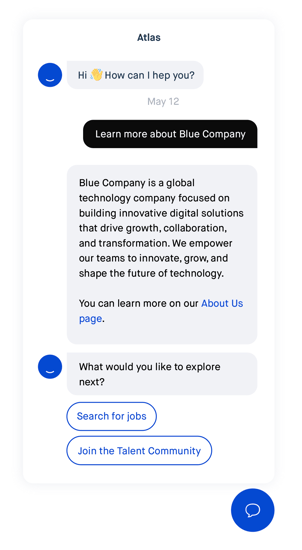
It combines structured flows with an AI agent.
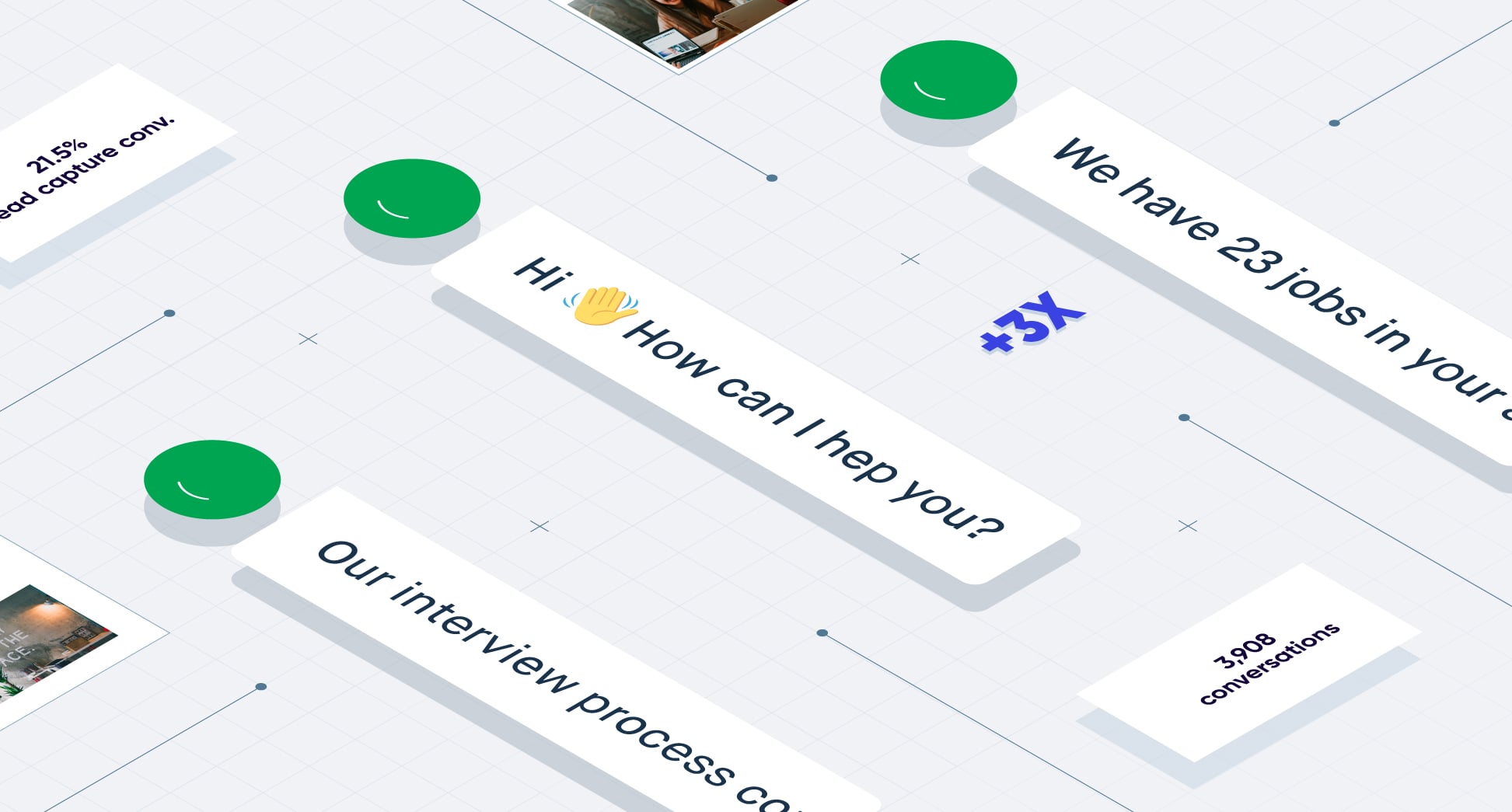
You define the core conversation paths, job search, talent community sign-up, company information, and the AI handles everything outside those paths, drawing exclusively from your content. The result is a chatbot that feels like a knowledgeable member of your team, available 24/7, in any language.
It's built for lead capture.
Every interaction is an opportunity to capture candidate details directly into the SmartDreamers CRM, enabling follow-up nurturing campaigns without any manual work. When a candidate signs up through the chat, they're automatically enrolled in the right audience and eligible to receive job alerts or nurturing sequences.
It's page-specific.
You can deploy a different chatflow on your Engineering page, your Graduate programs page, and your global homepage — each with its own questions, its own lead capture form, its own knowledge base, and its own branded design. Visitor rules let you show or hide the chat based on country, device, browser language, or referral URL.
It surfaces real jobs inside the conversation.
The Search Jobs block connects directly to your live jobs library, so candidates can discover and filter open roles without ever leaving the chat. When no matching roles are found, the flow can automatically route to a talent community sign-up, converting an empty result into a pipeline opportunity.
It's fully branded.
Custom colors, avatars, placement, and personality settings mean the chatbot can reflect your employer brand precisely, not look like an out-of-the-box widget dropped onto your site.
It's GDPR-ready.
Built-in cookie consent and data processing consent options are configurable per chatflow, with customizable consent text to meet your jurisdiction's requirements.
Consultancy for implementation
One lesson we’ve learned from speaking with organizations that have already deployed chatbots is that there is no universal implementation strategy. Many chatbot deployments take a broad approach, using the same experience for every candidate regardless of audience, location, or career stage.
We don’t believe that’s the best approach.
The effectiveness of a chatbot depends heavily on candidate persona and context. Early-career candidates, for example, often have more questions about the company, hiring process, benefits, and opportunities available to them. In these cases, a conversational experience can be highly valuable. Candidates applying for senior or executive roles, on the other hand, typically arrive with more targeted intent and may engage less with chatbot interactions.
That’s why we encourage clients to think carefully about where and how a chatbot is deployed. In some cases, it may make sense to focus chatbot experiences on early-career, graduate, or high-volume hiring pages while using different engagement strategies elsewhere. In other cases, we may even recommend against deploying a chatbot in certain sections of a career site altogether.
Our goal isn’t to maximize chatbot usage. It’s to help employers create the right experience for the right audience at the right moment.
Built for Talent Acquisition Teams, Not Developers
One thing we were intentional about: this tool should be accessible to recruitment marketing and talent acquisition professionals, not just developers.
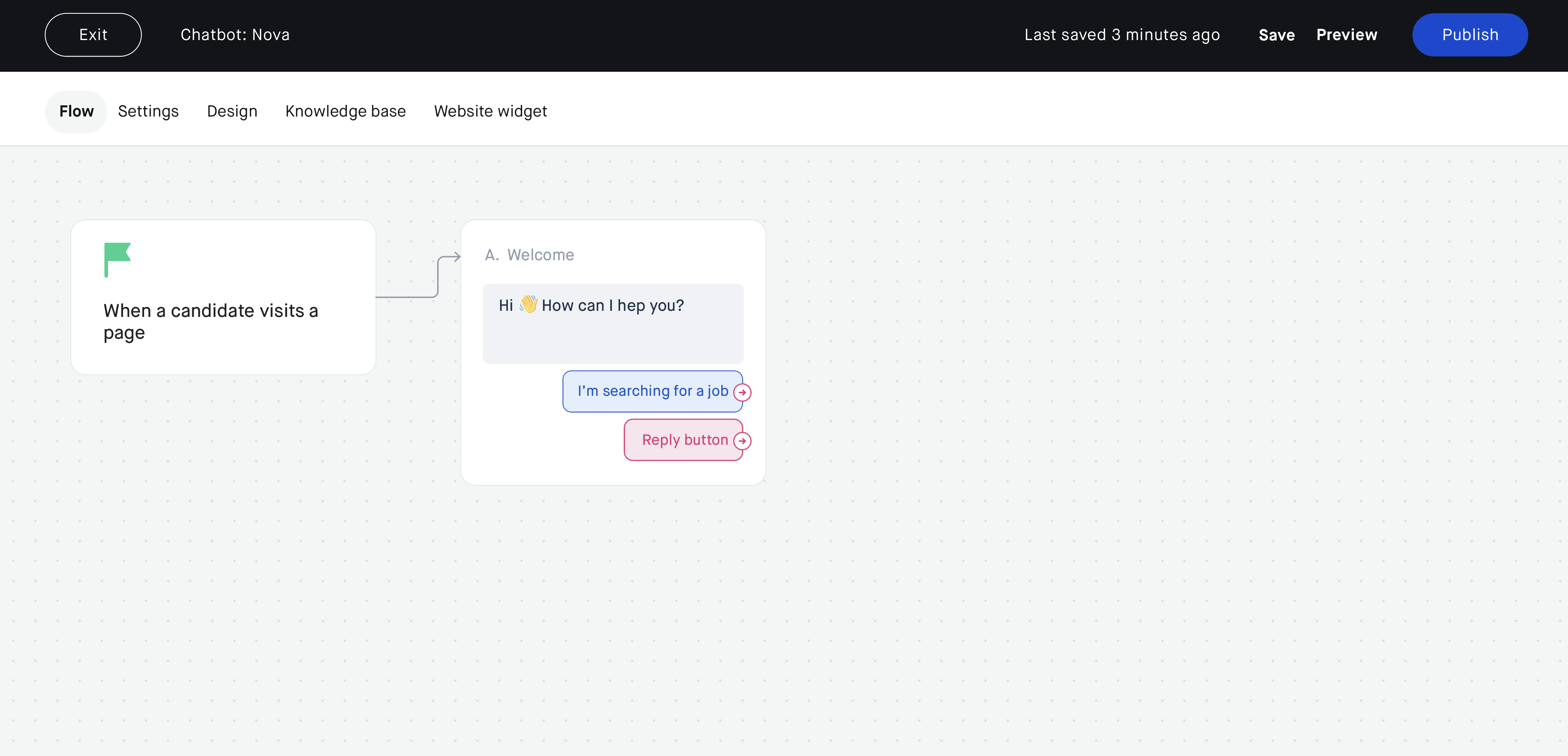
The visual flow builder uses a drag-and-drop interface, no coding required. Building a chatflow is a matter of designing a conversation map, connecting blocks, configuring a knowledge base, and designing the widget. Installation on your career site requires pasting a single JavaScript snippet into your site's HTML.
The AI knowledge base is equally straightforward: enter your careers website URL to crawl and index it automatically, upload PDFs for deeper content, and write a custom prompt to give the AI specific instructions about tone, topics to avoid, or anything else that requires nuance.
What This Means for Our Clients
If you're already a SmartDreamers client, the Chatbot is a native extension of the platform you already use. Lead capture flows directly into your existing CRM audiences. Job search connects to your existing jobs library. Analytics sit alongside everything else in your SmartDreamers dashboard.
If you're new to SmartDreamers, the Chatbot is part of a broader recruitment marketing platform built specifically for career sites, covering everything from candidate attraction and CRM to job distribution and employer brand content.
Ready to See It in Action?
We've been thoughtful about when and how we brought a chatbot to market. We think the result reflects that care.
If you'd like to explore the SmartDreamers AI Chatbot for your career site, reach out to our Sales team. We're happy to walk you through what a deployment could look like for your specific career site, audience, and employer brand.
The technology is finally where it needs to be. And now, so is the product.